
On the morning of October 31, 2025, a delegation led by Jiang Hanjun, Vice Dean of the School of Integrated Circuits, Tsinghua University, visited the School of Electronic Science and Engineering, Nanjing University for an exchange. Centered on the core topic of Large Model-Assisted Chip Design, this exchange aimed to promote in-depth dialogue and cooperation between the two universities in the cutting-edge field of integrated circuits.
First of all, Jia Xiaoqing, Vice Dean of the School of Electronic Science and Engineering, Nanjing University, Jiang Hanjun, Vice Dean of the School of Integrated Circuits, Tsinghua University, and Du Li, Vice Dean of the School of Integrated Circuits, Nanjing University and Director of the Intelligent Sensing and Communication Laboratory (ISCL), delivered speeches respectively. Both sides agreed that against the backdrop of the rapid development of artificial intelligence technology, jointly exploring new methods of AI-enabled chip design and new models of education is of great strategic significance for cultivating high-end integrated circuit talents oriented towards the future and promoting the independent innovation of China's chip industry.
In the thematic report session, Professor Du Yuan, Assistant Dean of the School of Electronic Science and Engineering, Nanjing University and Deputy Director of the Intelligent Sensing and Communication Laboratory (ISCL), delivered a special report entitled Report on the Construction of Large Model-Assisted Chip Design Courses. He elaborated on the undergraduate-master integrated course Application and Practice of Large Language Models in Chip Design that he took the lead in launching. In terms of teaching content, the course took the lead in introducing AIGC technology and related large models into key design links such as digital logic design, analog schematic design, chip verification and physical design; in terms of teaching methods, the course integrated various educational technologies such as inquiry-based learning, team-based learning and CD engineering practice teaching, making bold innovations and reforms to the traditional integrated circuit design education model.
This exchange activity was compact and fruitful. It not only deepened the mutual understanding between Tsinghua University and Nanjing University in the field of integrated circuits, but also laid a solid foundation for further cooperation between the two sides in AI for EDA (Electronic Design Automation), talent training, scientific research projects and other aspects.
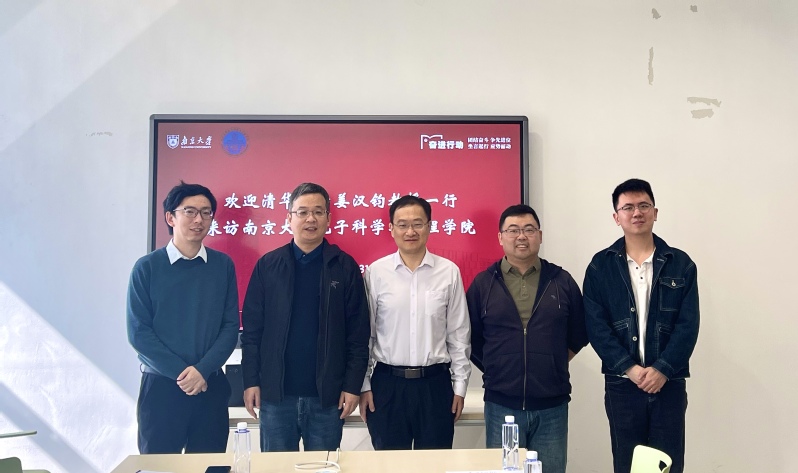
Group Photo of Participants
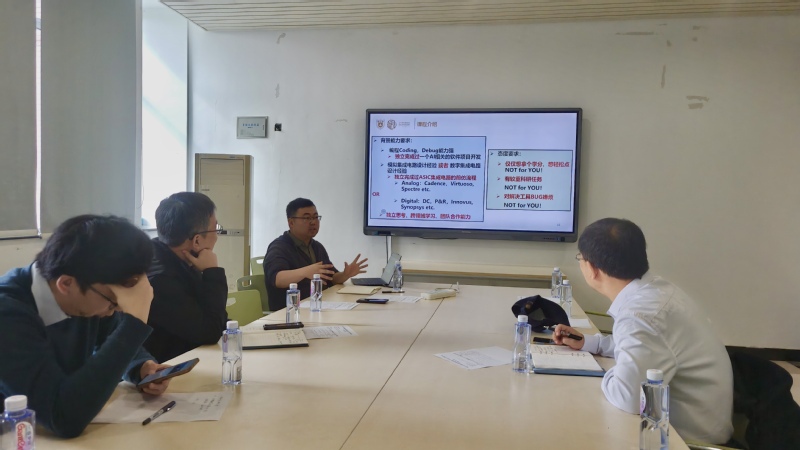
Special Report Entitled Report on the Construction of Large Model-Assisted Chip Design Courses